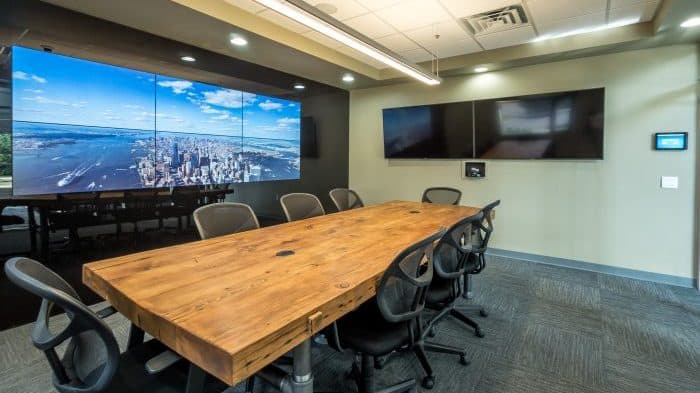
Video walls deliver the wow factor and imbue commercial space with the modern look associated with forward-looking companies. They display content in a way that is unique and captures the attention of your audience.
However, the high cost — or at least the perception of a high cost — associated with display technology at this scale has kept many businesses from building their dream video wall.
You can absolutely build one without breaking the bank. This article gives you a general overview of what a commercial video wall costs, from a simple array to a much more elaborate setup, so you can narrow down the size, style, and price range that fits your needs. As a frame before we start: a single commercial display with a media player starts around $2K–$5K, while true multi-display systems and LED video walls typically range from $15K to $150K+ depending on size and pixel pitch. Here’s where that money goes.
The overall cost of a video wall depends largely on size, display technology, the processor, and the quality of the mounts, along with installation — making video walls one of the most customizable pieces of technology you can install.
One more note before I break down the options. When I talk about video walls, I’m not referring to buying four TVs from a big box store and hanging them together. TVs are problematic as video walls for a number of reasons: their bezels are larger and carry logos, they’re usually not bright enough to serve as commercial displays, and they can’t meet the demands of 24/7 usage. You’ll hear me discuss LCDs and LEDs, but I’ll be referring to commercial monitors, not TVs. It’s an important distinction.
Okay, let’s get started.
Display technology
LED and LCD are the two display technologies used for nearly every video wall today. Generally, direct-view LED costs more than LCD for the same footprint, making LCD arrays the budget-friendly choice. The major trade-off is the LCD’s bezel lines against the LED’s seamless, line-free image.
Viewed from a distance, LED delivers one large uninterrupted picture that’s ideal for stage screens, corporate branding, and digital signage. Fine-pitch LED has also improved dramatically for close viewing — which is part of why it keeps displacing LCD in lobbies and boardrooms.
LCD walls
For simple walls, a 2×2 array of commercial LCD panels is the entry point and sits at the low end of the range; larger arrays and advanced features like touch interactivity climb from there. Mounting hardware, structure, and installation add to the panel cost — modest for a wall-mounted 2×2, more for freestanding or architectural installations.
LED walls
Direct-view LED is the premium option: seamless at any size, buildable in nearly any shape, and bright enough for any environment. LED is priced by area and driven by pixel pitch — the spacing between LEDs. The tighter the pitch (for closer viewing), the more the wall costs per square foot; coarser-pitch walls meant to be viewed from across a room or lobby cost dramatically less. Large fine-pitch walls occupy the top of the $15K–$150K+ range, but LED pricing has fallen steadily — walls that were out of reach a few years ago now fit real budgets.
Mounts
It’s best not to scrimp on mounts. Choose a mount rigid enough to prevent sagging, with alignment adjustment in every axis. Most importantly, use mounts that permit front serviceability of individual panels — so servicing one failed panel never means pulling its neighbors, which keeps maintenance fast and affordable for the life of the wall.
Processors
Video processors handle rotation, layering, and windowing of content and other custom effects. Depending on what you display and how, the processor can become one of the most expensive components of the wall. Cost tracks the number of simultaneous layers and the physical inputs and outputs required — from a few thousand dollars for simple windowing to tens of thousands for many-source, many-layer systems.
Some video wall monitors have tiling built in, so basic functionality already exists within the displays themselves. If what you’re displaying is simple and straightforward, you may not need a processor at all.
Also, custom content needs to be created (or scaled to fit) for walls that don’t come in standard resolutions. Try to use a layout that maintains standard aspect ratios — 16:9 or 16:10 for LED walls, and 2×2, 3×3, or other standard array sizes for LCD — or your content production costs will quietly eat the budget you saved elsewhere. Software can convert existing content to a desired aspect ratio rather than doing it in processor hardware.
Wrapping up
With the range in panel, processor, and mounting costs, there’s a video wall configuration for nearly any commercial budget. What isn’t advisable is DIY — a wall that sags, drifts out of alignment, or can’t be serviced costs far more in the end. We’ve designed and built these from conference rooms to an 8-panel engineering lab wall. When you’re ready to price yours, get in touch — we’ll ground the number in your space, your content, and your viewing distance.